Introduction
Before the castles, before the crowns, and long before the lies—Europe was Black. This isn’t just a poetic reimagining of the past; it’s a conclusion drawn from heraldic records, early portraiture, genetic studies, and suppressed historical documents. The original inhabitants of Europe were not pale-skinned Nordic tribes, but Black-skinned aboriginal populations who built the earliest European civilizations.
Let’s peel back the veil and journey into the true peopling of Europe.
1. The First Europeans Were Black
Archaeological and anthropological evidence shows that the earliest inhabitants of Europe—often referred to as Grimaldi man—were of African descent. These early migrants crossed from Africa into southern Europe over 40,000 years ago during the Upper Paleolithic period.
Skulls and skeletal remains unearthed in Italy and parts of France show clear Negroid features, according to early 20th-century anthropologists—descriptions now quietly removed from mainstream literature.
Even the famous Venus figurines—fertility sculptures found throughout prehistoric Europe—depict women with rounded, full features more in line with African phenotypes than anything Nordic or Anglo.
2. Black Civilizers and the Rise of European Culture
The peoples who brought agriculture, metallurgy, and city-building to early Europe were also of African origin. These were the Black Moors, Iberians, Etruscans, and Celts—nations that once spanned from Spain to Scotland.
Historians like Dr. Marie Charles and Lee Cummings argue that these Black populations weren’t just present—they were dominant. They developed kingdoms, trade systems, and spiritual cultures that laid the foundation for what we now call Western civilization.
According to Charles, many of the classical Greek gods and myths are stolen or adapted from these original African-European hybrid cultures.
3. Heraldry Doesn’t Lie: Coats of Arms and Black Nobility
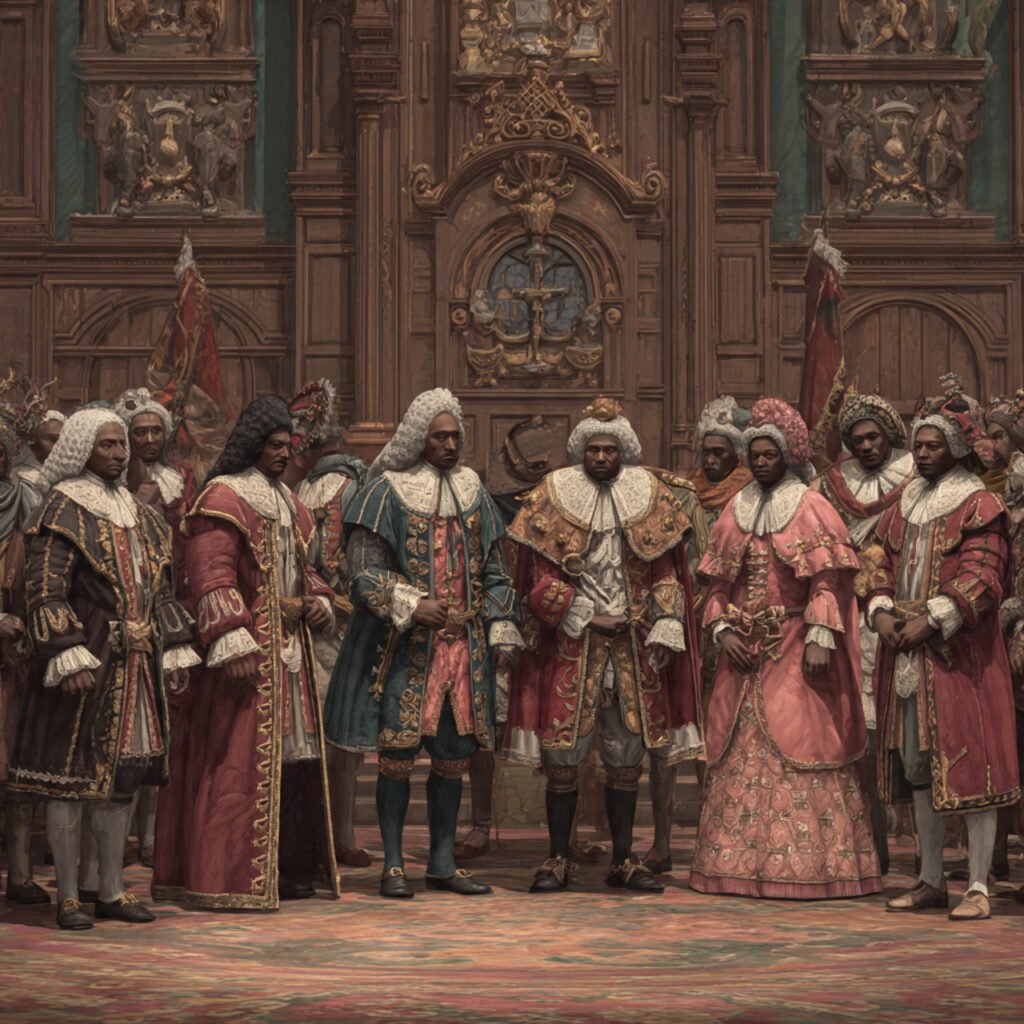
European coats of arms are visual family records—passed from one generation to the next. Many of these symbols include unmistakable depictions of Black men and women with crowns, armor, and weapons. These are not slaves or servants. These are nobles, monarchs, and war chiefs.
The Wappenbuch der Stadt Basel and other heraldic rolls from the Holy Roman Empire, Portugal, and even Scotland feature Black figures central to the family’s identity.
Why? Because these families were originally Black. Over generations, skin tones changed due to intermarriage and conquest—but the symbols remained.
This is what Egmond Codfried refers to as “the heraldic fingerprints of a forgotten elite.”
4. The Whitening of Europe
The whitening of Europe wasn’t a natural evolution—it was a systematic purge. Beginning in the Renaissance and accelerating through the Enlightenment and colonial periods, Europe’s Black noble lines were painted over, rewritten, and reclassified.
Paintings of Black kings and queens were “retouched” to reflect lighter skin. Historical accounts were revised or deleted. Portraits, once proudly displaying African features and royal regalia, were hidden or destroyed.
Benjamin Franklin’s 18th-century writings even describe southern Europeans as “swarthy” and praises the New World for offering a clean slate—one free of Black European influence.
This wasn’t mere prejudice. It was a calculated erasure of memory.
5. Expulsions, Enslavement & the Great Cover-Up
The so-called “Black Irish” and “Black Scots”—terms once widely used—were among the first casualties of this erasure. During the Highland Clearances, Cromwellian campaigns, and various civil wars, thousands of Black European nobles and freemen were stripped of title and land.
They were often sent to the Caribbean and American colonies as indentured servants or slaves. Many of the people today called African Americans, Afro-Caribbeans, or Creoles are likely the descendants of these disinherited European royals.
Lee Cummings notes that “the transatlantic slave trade had many doors—and one of them was Europe itself.”
6. Why You’ve Never Heard This Before
This story is not in your schoolbooks for a reason. It destabilizes the very core of Eurocentric identity and the myth of white racial superiority. Recognizing that Black people were not only in Europe but ruling over it—forces a total rewrite of world history.
It also explains the deep, often irrational hostility toward Black descendants in the West. If you were once ruled by a people you now claim are inferior, your entire worldview is a house of cards.
Conclusion: Reclaiming the Timeline
Europe was not born white. It was blackened by its origins and only later bleached by distortion. By recovering the timeline of Black Europe’s rise, rule, and erasure, we empower the diaspora with knowledge that reclaims dignity, identity, and place.
The kings, queens, and visionaries of Europe’s past didn’t vanish. Their blood runs in many of us. Their story is waiting to be retold.